
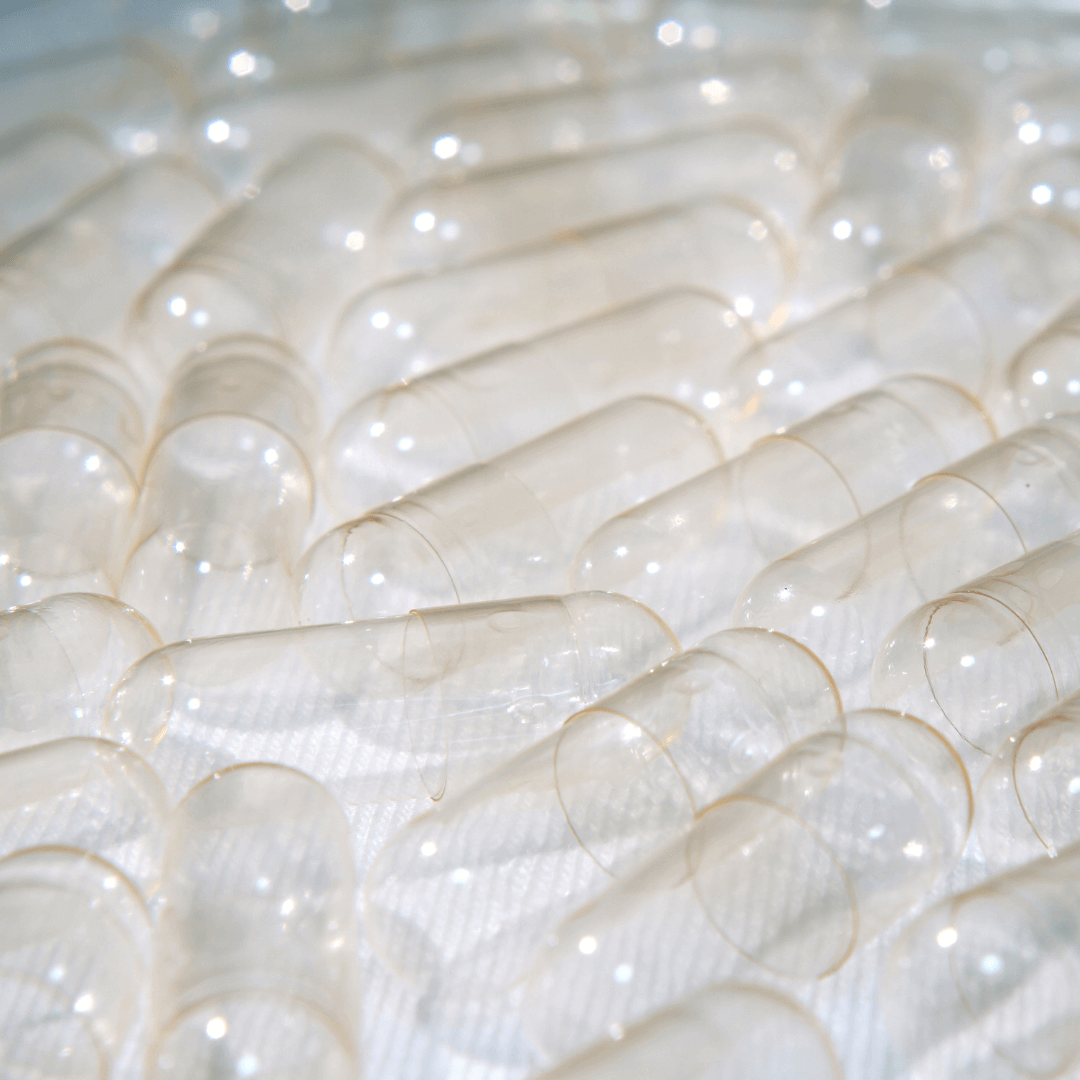
Medication training for your cat: all about gel caps!
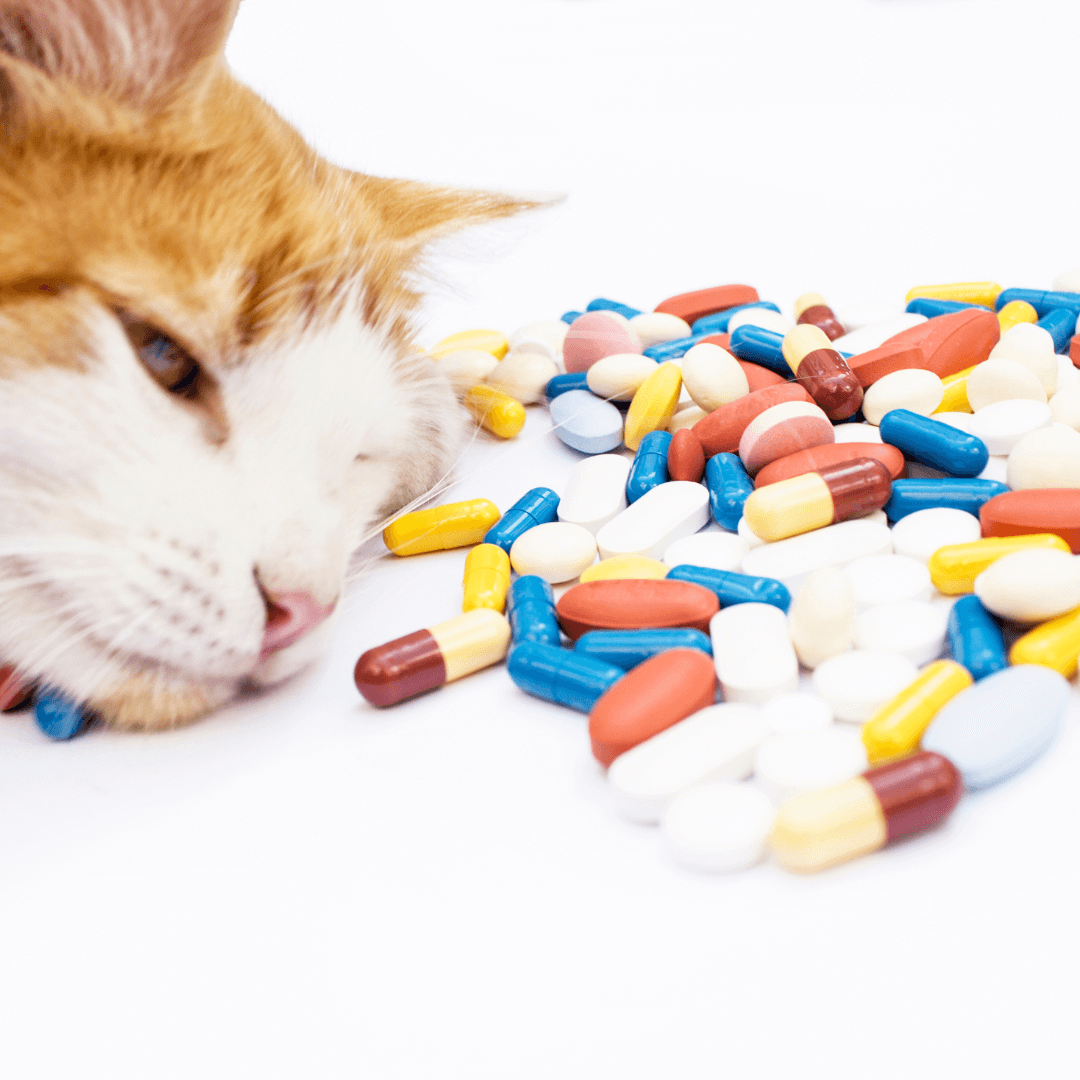
So, who here likes medicating their cat?
(Taps mic). Is this thing on?
Giving oral medications to your cat can be one of the most stressful things that cat parents have to do. It’s made even more stressful because there’s a REASON why your vet has prescribed this medication, and now your whole life has become finding ways to cram this horrible tasting pill down your cat’s throat, trying to outsmart your cat by unsuccessfully hiding it in their food, and stumbling upon the half dissolved pills that your cat has spit out around the house.
Similarly, taking oral medications can also be one of the most stressful things for your cat to endure! They can’t trust their food because now it tastes like poison, so they develop a food aversion and go on a hunger strike. The person they know and trust is sneaking up on them to grab them when they’re napping and shove something bitter in their mouth that makes them foam, so now they have to hide, flee, bite, or scratch when they see you coming at them. Not only does this prevent your cat from getting their much needed medication, but it tests the human-feline bond and causes significant emotional distress for both you and your cat. It can also lead to serious injury.
Nothing to see here except us chickens.
As a fellow pet parent, I’ve been there. I struggled for years to medicate my former dog Dorie, who had numerous complex medical conditions that required 15 oral medications a day at the end of her life. Her severe inflammatory bowel disease (IBD) made her a picky eater, and due to countless failed attempts to hide her meds in food and treats, she was even pickier when it came to taking her meds. The more meds she needed, the harder it got for both of us. Towards the end, medication time became a twice daily nightmare where my partner and I would coax and encourage her to take each pill or capsule, which could take 20 minutes or more per session. This often led us to prioritize the most important of her medications since that’s what we could get in her at the time.
As challenging as it was to medicate Dorie, her meds improved her quality of life in immeasurable ways by helping her feel better and control her symptoms, so we persisted. We used treats and praise throughout and countless other medication tricks of the trade, but the single most important tool that allowed us to keep Dorie with us for 4 years after her IBD diagnosis and multiple health issues was the gel cap.
15 meds a day? Yeah, I’ll pass.
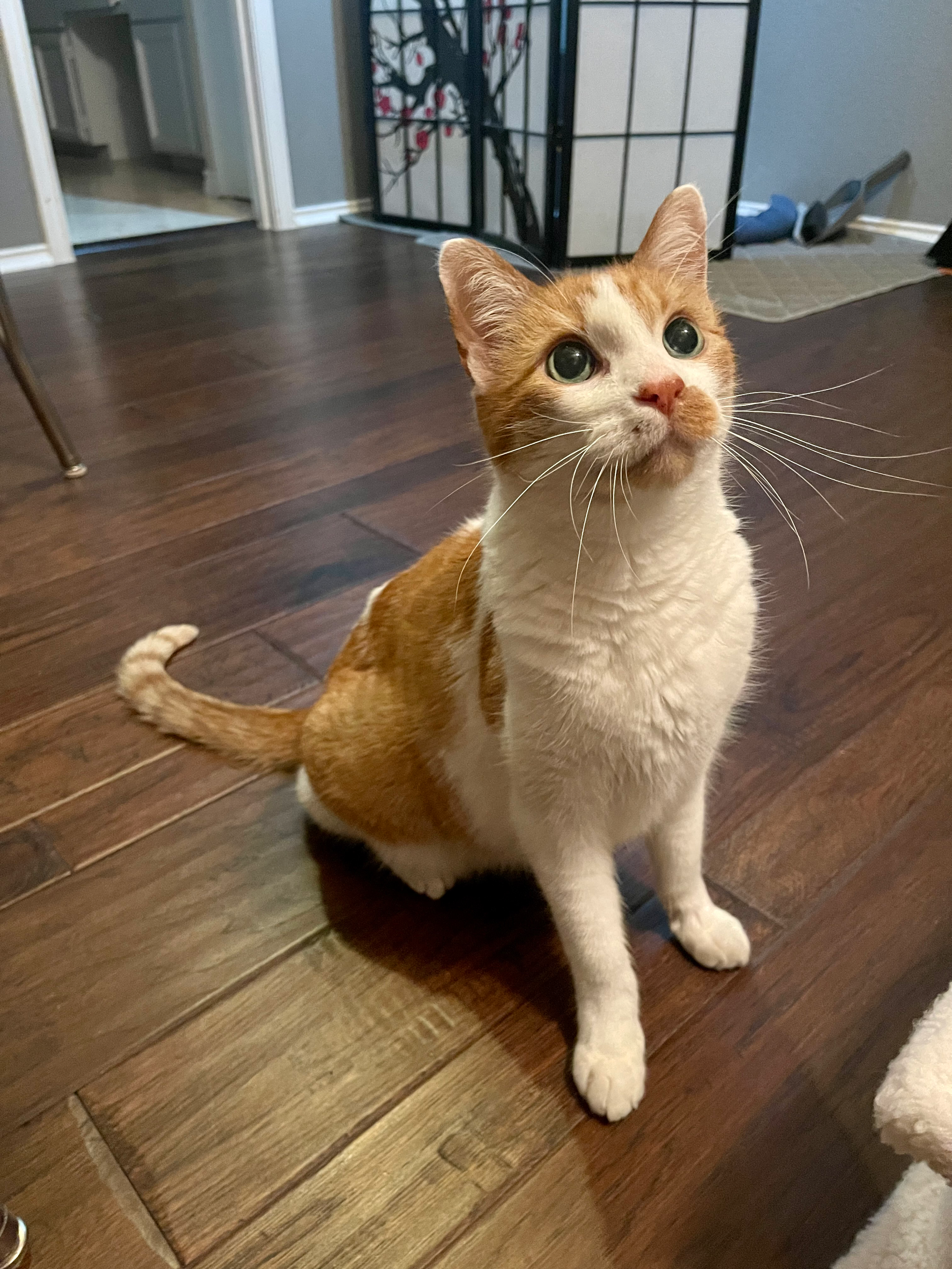
Sadly, we lost Dorie in June of 2023, but around that time our relatively robust senior cat Puff began developing worsening health issues that also required meds, which used to be one of my biggest fears. Puff was always very difficult to medicate, and could sniff out anything hidden in food, so I always worried about what would happen if Puff began needing the same level of care as Dorie.
My turn!
After going through gel cap boot camp with Dorie, we introduced gel caps to Puff. Using positive training that I describe in this blog, we’re now able to give him several meds a day that he thinks are a treat. Supporting his physical health and emotional health through this medication trick makes me feel so good as a cat parent and a veterinarian, and simply would not have been possible without gel caps and a positive reinforcement-based approach.
Gel caps FAQ
-
Gel caps (short for gelatin capsules) are clear, odorless and flavorless empty capsules that you can use to hide your cat’s oral medications.
-
Definitely. All cats will eventually need oral meds at some point, and using gel caps will open up a whole world of options for treatments. I routinely see cats in the clinic who can only be medicated by injection, and compared to the number of oral medications, there just aren’t that many injectable options for cats, which leaves fewer treatment options. Not only that, but injectables are more expensive and they require a trip to the vet, which we ALL know cats love. Learning the gel cap method will train your cat for taking oral meds when needed.
Some examples of oral meds routinely prescribed by vets:
Gabapentin to treat pain or to reduce stress for vet visits
Other situational or maintenance behavioral medications to help reduce fear, anxiety, and stress
Dewormers to treat parasites such as roundworms or tapeworms
Antibiotics for conditions such as a urinary tract infection
Antihistamines to help with chronic upper respiratory infections or allergies
Anti-nausea medications
Steroids like prednisolone for feline asthma or inflammatory bowel disease
-
There are so many!
Your cat won’t taste or smell their meds because they’re hidden inside the cap
If you use the brand we recommend (see below), they can be used to hide liquid meds as well such as antibiotics
They allow you to combine multiple pills into one cap, which means fewer gulps to get the meds down. (Note: talk with your vet about whether it’s okay to combine your cat’s particular meds into one cap).
If your cat needs regular pills, you can batch prep the gel caps ahead of time and fill a days-of-the-week meds box to make medication time more efficient. This also makes it so much easier for petsitters!
They’re relatively inexpensive
They can ensure easy, positive, consistent dosing for your cat, which is vital for their health and better for everyone’s emotional health!
-
Cat parents with issues such as arthritis in their fingers may find it difficult to handle and fill the caps
It takes time to prep the meds and fill the caps. But I would argue, way less time than whatever ineffective medication technique you were using before!
When filling the caps with liquid meds, you must fill them carefully and avoid getting ANY on the outside of the cat or it will taste bad for your cat.
You will likely need to do some trial and error and training to get your cat to take them reliably
Your cat may potentially crunch into them and taste the meds. However, you can avoid this by using only smaller caps if possible and following our other training tips.
If you leave them sitting in canned food, they will soften and eventually dissolve which completely defeats the purpose. They’re most effective with immediate use.
-
Torpac! They lock and come in multiple different sizes. I recommend the smallest size cap that will fit your medications to make it easier for your cat to swallow. Most cats will use size 3 or 4 caps depending on the medication size. Size 2 is the largest I would use for cats. Size 5 is helpful if you’re giving a partial pill or working on gel cap training for your cat.
Here’s the Torpac size chart for their small animal gel caps, which also includes the milliliter capacity for liquid meds.
-
Depending on what types of oral meds you’re using, some meds can fit directly into the cap. Others may require splitting or cutting, such as with this multiple pill splitter. Talk with your vet about whether it’s okay to split/ cut your cat’s medication. The danger with doing this when a tab isn’t scored is that your cat may not get an identical dose in each half or quarter if you’re only giving a partial dose at a time. Your vet can also likely get your cat’s oral medication compounded into a smaller tab that can fit inside the cap through a special compounding pharmacy.
To fill, simply open the cap, load the meds, and lock the cap by squeezing the rounded ends towards the seam. You should feel a tiny click.
Remember, always wash your hands after handling any pet medications!
For a quick video summary on gel cap prep made easy, click here.
-
Probably not. You’ll need to find something tasty to coat the outside. See more in the training section.
-
Definitely! For example, vets commonly prescribe 100 mg gabapentin caps for their feline patients to help reduce stress before vet visits, or for home stressors such as storms, visitors coming to the home, etc. If your cat needs one 100 mg cap gabapentin before vet visits, you can cover the cap with whatever tasty treat your cat enjoys.
Gel cap training
Step 1.
Find a sticky/ moist treat or canned food that your cat LOVES that you can use to cover the cap. Suggestions: Easy Cheese, Churu, cream cheese, whipped cream, stinky pate-style canned food, pureed meaty baby food like ham or turkey (check to ensure no toxic onion powder!). Churu Bites are another treat that work well—think of them like Combos for cats, where you can tuck the gel cap into the Churu-filled center. For cats on prescription diets, ask your vet about whether you can use another flavor of canned prescription food for training.
The key is to have it be a special, high value treat for your cat, which usually means giving them something in a small amount that is not part of their regular meals.
You can also see if your vet carries Royal Canin Pill Assist, which are super palatable, Play-Doh like pill hiders that can be molded around a gel cap or pill. In my experience most cats won’t eat Pill Pockets or Pill Paste, but they will eat Pill Assists. Some cats also like mini marshmallows, which are perfect for hiding a little gel cap. I’ve also had some success with catnip flavored Pill Pockets. It’s always a good idea to check with your vet about whether a certain treat is okay for hiding the cap.
Step 2.
Pick a consistent place (a medication station) and a consistent time every day so your cat learns the routine, ideally when your cat will need their medications.
If you’ve trained your cat to station on a mat (which I highly recommend, check out these resources through Cat School and CattleDog Publishing!), you can put the mat to work by placing it down as a medication station in the location you’ve chosen. We use the kitchen because that’s where Puff’s food, meds, and treats are stored. As soon as we put his mat down, he stations immediately and enthusiastically because he knows that good things (treats, attention, praise) are about to come.
If you haven’t done any mat training with your cat, no problem. You can still proceed with the other steps outlined in this training, but mat training gives you a leg up because your cat will already have a positive emotional response associated with going to the mat.
Our goal with this step is teach your cat a routine and encourage voluntary movement to support choice and control, which minimizes fear/ anxiety/ stress. No more chasing your cat around to get their meds!
Did someone say treat?
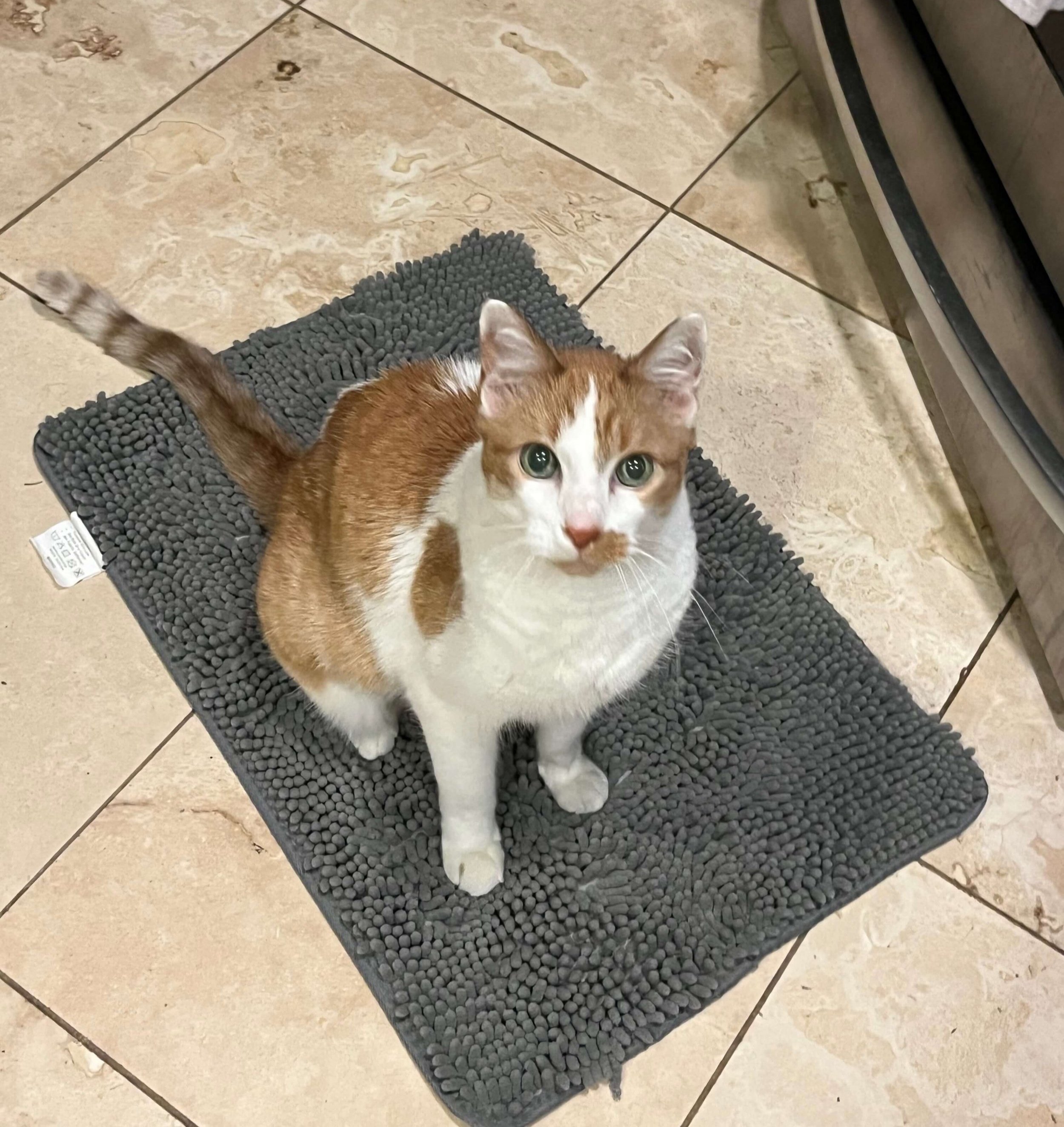
Whatevs, random grey cat. I can station on my mat AND at my medication station!
Step 3.
Put a blob of treat onto a small plate, and call your cat over in a happy voice. When they come over, praise and toss them a favorite dry treat. If your cat is clicker trained, you can click/ treat/ praise your cat for coming over to the medication station.
Put the plate down and let them lick it. Immediately praise your cat in a happy voice for licking the sticky treat and quickly follow up with a dry treat (or click/ treat/ praise).
Why bother giving them another treat for eating the sticky treat? Because with reward-based training, we want to reinforce the desired behavior. In this case, we want to say, “Good kitty!” for eating that sticky treat because soon it’ll have a gel cap!
The goal for this step is to begin conditioning positive emotional responses around your cat’s medication station and with the routine.
Step 4.
Repeat step 3 every day at the same time every day until your cat comes zooming over for their special treat. It shouldn’t take long.
Step 5.
Cover a locked, EMPTY gel cap with the sticky treat and put the plate down. Torpac size 4 is a good default size for training. For kittens or more sensitive cats, start with size 5. Your cat may be confused when they first bite into the gel cap, so immediately put down that second treat so they don’t have time to think about it. Praise and more treats!
Step 6.
Repeat step 5 every day at the same time every day until your cat is eagerly eating the cap.
Step 7.
If this goes well, you can officially move onto filled caps and medicating your cat!
Gel cap troubleshooting
What do I do if my cat bites into the cap and spits it out?
Do some training sessions where you cover a dry treat with a blob of the sticky treat so your cat gets used to biting something hard that tastes good. Once that goes well, you can transition to using Torpac size 5 caps, and then gradually larger and larger up to a max size of 2.
Most cats do much better with taking two smaller gel caps (e.g., two size 4 caps) than forcing them to take one larger cap (size 2 or 3). Cats’ mouths just aren’t that big, and we want them to be able to swallow the cap comfortably.
If your cat is biting into the cap, make sure you don’t have too much good stuff around the cap. If it’s too big your cat is more likely to chew, so you may need smaller caps.
You can also use the 3 meatball trick: first one has just a treat, second has treat + cap, third is treat only. Roll or give them quickly so your cat gobbles them up!
What do I do if my cat just licks the stuff off and leaves the cap?
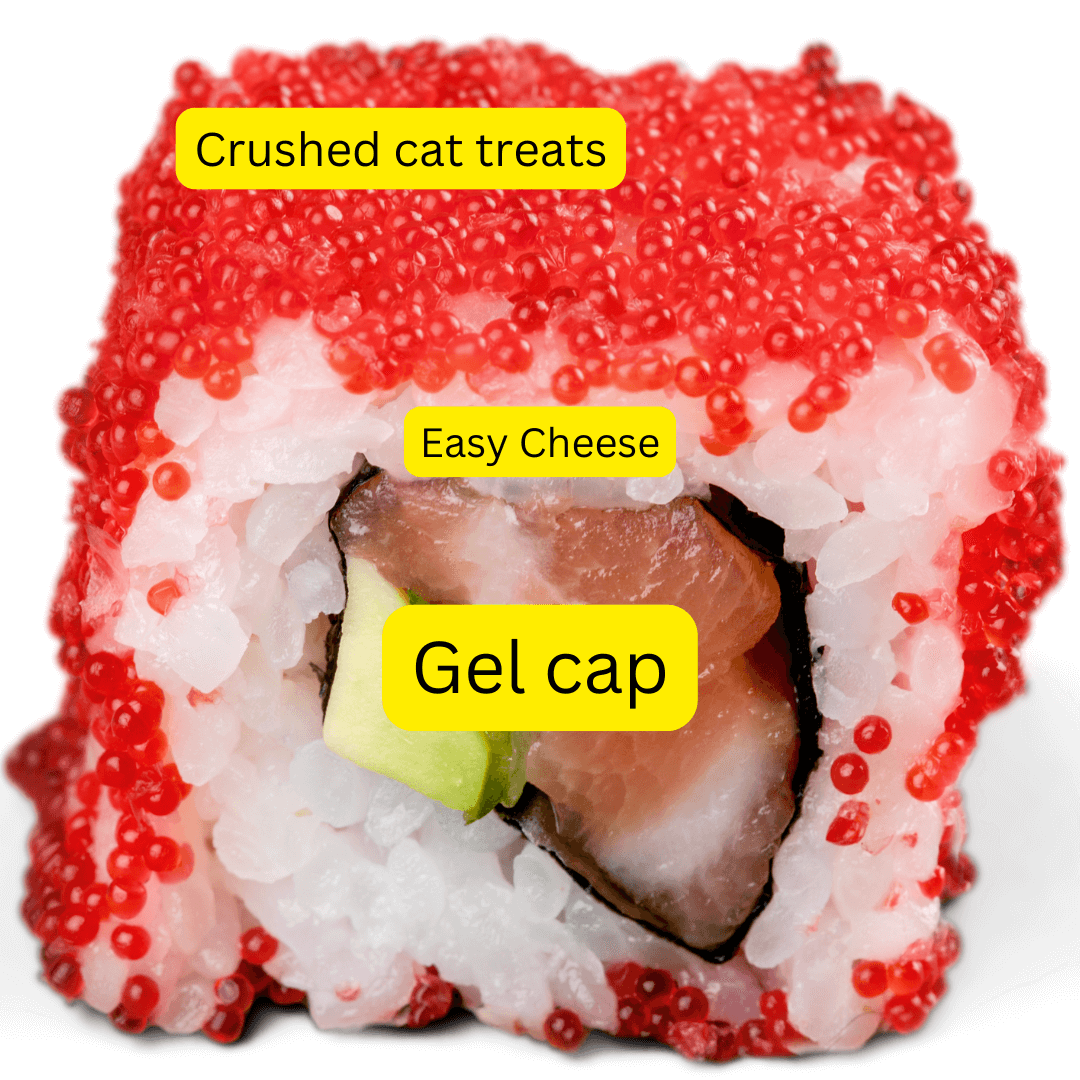
Instead of using a smooth plate where the cap may just roll away from your cat when they lick, try a finely textured Lickimat that will hold it in place without trapping the cap. The Lickimat Classic Soother for cats has multiple tiny nubs. You can also cover it in crushed dry treats (see sushi roll tip below).
What if my cat is on a special prescription diet and isn’t supposed to have treats?
Talk to your vet! These days there are multiple prescription treat options for cats that are generally okay to give if your cat has urinary issues, a food allergy, or inflammatory bowel disease. Another option is giving your cat a different flavor or brand of their prescription food as a treat, or the canned version of their current diet to change things up. Being able to give a special treat that your cat loves will make medication training so much easier. Puff has suspected inflammatory bowel disease and loves his Royal Canin hydrolyzed treats.
What if my cat is a dry food addict like Puff who doesn’t like canned food or any of the other sticky treat options?
Use the sushi roll approach! Crush your cat’s absolutely FAVORITE dry treats (Party Mix is a good option), roll the gel cap in the most palatable of those sticky treat options, and then roll it in the crushed treats.
Try coating the outside with tiny shreds of cooked chicken breast or another fave treat
Try the three meatball trick again: the first one is a special treat (e.g., chicken breast cube or Party Mix), the second one is the covered gel cap, and the third meatball is the special treat. Give each in quick succession, praise and final treat when done.
Alternatively, check out the previously mentioned Churu Bites! The outer shell is semi-crunchy for cats who prefer that texture, and you can tuck the gel cap into the center.
What if my cat seems suspicious or frustrated during training, doesn’t want any of the treats, or I need more help?
Many cats have underlying GI disease (think chronic intermittent vomiting, nausea, picky eating, or soft stool) or other health conditions that can make them not feel well. When cats don’t feel well, they’re not going to be in a good place mentally for training. If your cat is showing any concerning physical signs, make an appointment with your vet!
Make sure you’re not pushing your cat too quickly during each of these steps. Training should always progress at your CAT’S pace and comfort level, not where you think your cat should be. Each training session should be short (< 5 minutes), positive, and end on a good note.
Some cats find brushing, attention, petting, or playtime with a special toy more rewarding than treats, so these can be used as the reinforcer during training. However, treats typically work best.
If you still need help and you’re within the window of email support included with your consult, reach out! If that window has passed, you can still reach out to us about booking another consult so we can guide you through the training process.
For new patients needing medication and behavioral help in the Austin area, we’d love to see your cat for an initial in-person cat behavior housecall.
If you’re not a current patient, remember that this is a generalized guide and not intended for specific medical advice. It’s always best to speak with your kitty’s vet about gel caps and gel cap training to ensure that you’re receiving the best individualized care for your cat.