
Cat training for medication time
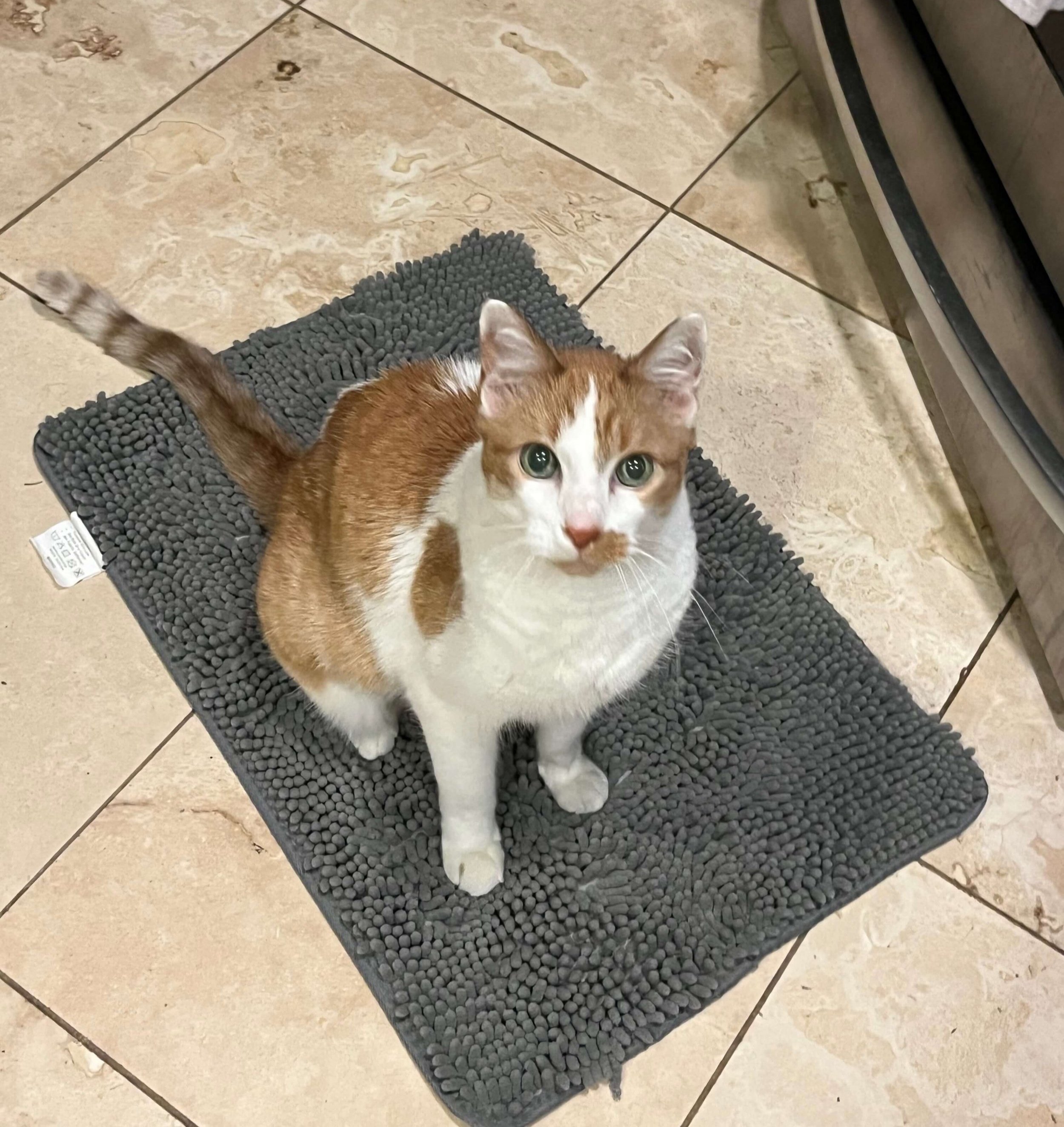
If you haven’t read my related blog posts on positive gel cap training for your cat and making medication prep more efficient, you may be thinking that cat training is for cat parents who have the spare time to work on a fun enrichment activity with their cat, but not essential.
This couldn’t be further from the truth! Every cat will need to take medications at some point, and doing some groundwork training now with your cat will pay off exponentially in the future, especially during times when you really need it.
Case in point: as many of my clients know, I needed to take some time off for rotator cuff surgery in 2025, which meant 6 weeks with my right arm in a sling. While my partner Brian was a big help as always, without him, even if I wanted to medicate my senior cat Puff the old school way (by “pilling” Puff and putting medication directly into his mouth, which is typically very stressful for cats), I would still be helpless to provide essential medical care for Puff.
Luckily, even without the use of one of my arms, I was able to medicate him easily, successfully, and positively because I’d taken the time to do two types of cat training a couple of years prior to my surgery:
Teaching Puff to station on a mat. This is a training concept where you use positive reinforcement to teach your cat to go to a location for treats, such as the Gorilla Grip non-slip mat I use for Puff. It has multiple uses with cats, including as a medication station to support choice, for positive carrier training, for managing intercat tension, and even with nuisance behaviors such as door darting or countersurfing.
Teaching Puff to take medications in a gel cap. Puff’s gel cap hiders of choice are Royal Canin Pill Assists, which most cat parents can get from their veterinarian. He loves them and thinks they’re a treat!
Yes, I am just that cute. Now stop taking pics of me and give me my Pill Assists.
To see how it all comes together, watch and rewatch this video of me in my sling medicating Puff. Note:
How this approach supports choice, control, and voluntary movement. I’m not forcing Puff to approach me, I’m not going to Puff to medicate him. He’s choosing to station and to opt into his own care. At any point, he can move off the mat which is my signal that he’s done. I use this same mat and same concept for other types of care including applying his monthly Revolution (flea/ heartworm topical prevention), brushing him, and trimming his nails. Giving cats agency in their own care is a high level concept called cooperative care, and it’s the goal with all medicating and husbandry.
How much he LOVES stationing because he’s gotten so many treats on it and associates it with good things. At the beginning of the video, you can see him putting up his arms in anticipation of getting on the mat. To help reinforce this, I always give him a treat immediately when he stations, and intermittently treat whenever he’s actively stationing. I also immediately toss him a treat after giving him his Pill Assists.
How easy and stress-free the whole process is for both of us. I ask my petsitters to use this same approach and it helps maintain his normal routine, which helps minimize anxiety. I also don’t have to worry about petsitters struggling with him, or causing fear/ anxiety/ stress, which could lead him to not receive the meds he needs and impact his emotional welfare.
How cats can be trained no matter how old they are. I didn’t teach Puff to station or to take gel caps until he was around 15. I think back to how my previous cats received care and wish I’d learned about these training techniques back then. Time frame wise, there will be some trial and error when it comes to gel cap training, but I was able to train Puff to station after about a week. He now gets medicated 4X a day and medicating him couldn’t be easier.
For more tips on helping the emotional health of your cat, book a cat behavior consult in the Austin area and follow My Family Cat on Instagram or Facebook!