
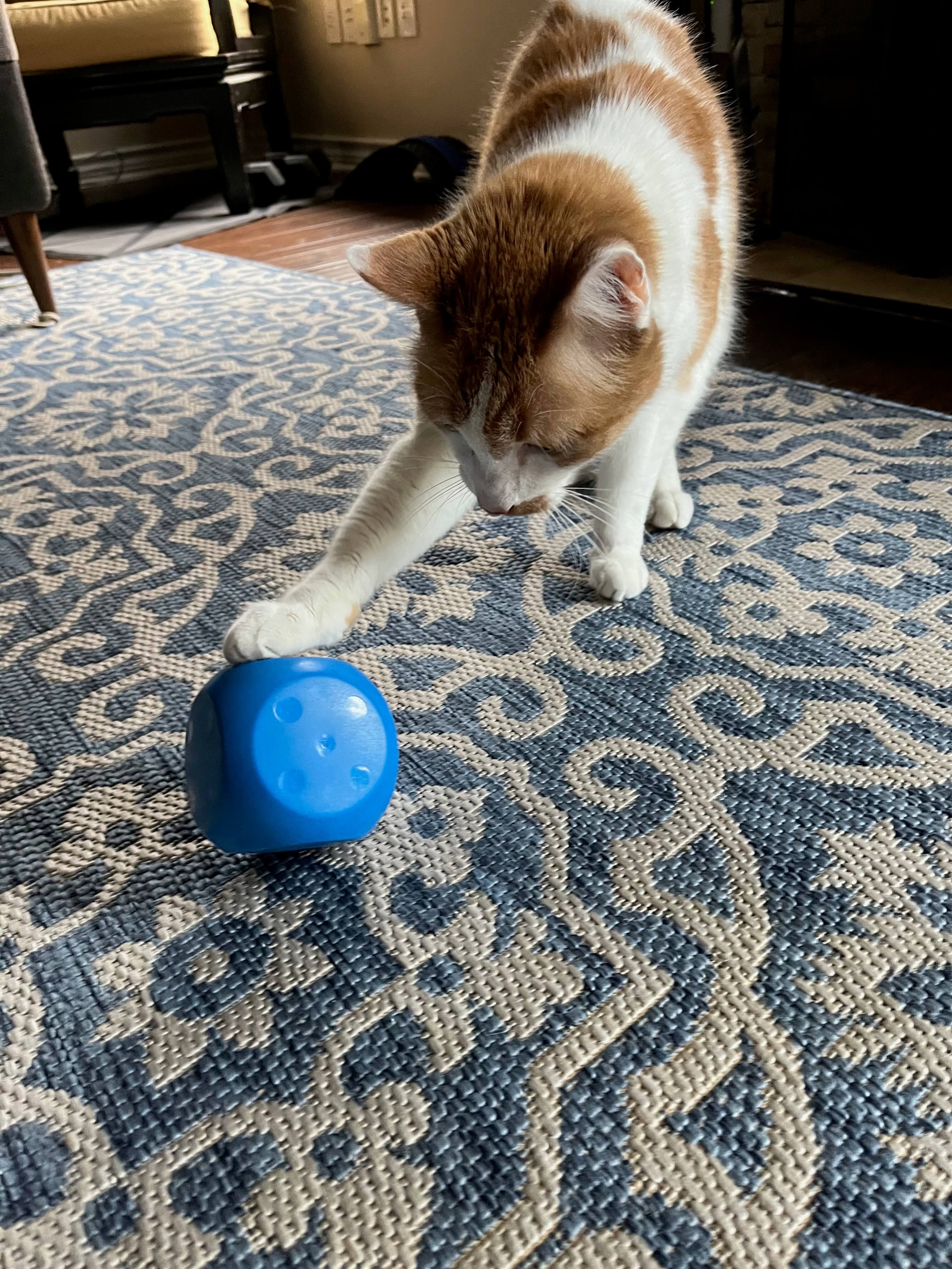
Our fave feline enrichment products and bonus resources!
The most fun part after a consult? Shopping for your cat!
Enrichment (ways to provide mental stimulation for your cat) and optimizing your cat’s environment are essential to supporting your cat’s emotional wellbeing, and recommendations for both are included with all of our cat behavior consultations. We’re so passionate about enrichment/ learning about cat behavior that we put together a list of some of our favorite enrichment products and additional resources for your kitty!
To avoid decision fatigue, think about your cat’s personality and what styles of play they like. Each item is hyperlinked so you can click to read more and purchase. My Family Cat doesn’t earn any income for recommending these products, they’re just items that our cats or cats we know have enjoyed!


FOOD ENRICHMENT
Foraging and hunting are natural behaviors for cats. When we feed exclusively from a bowl, we risk making our cats bored and frustrated after they gobble up their food and the next meal is hours away. I love food puzzles because they engage cats both mentally and physically, so help with enrichment and exercise. Cats also do better with multiple small meals throughout the day vs. being fed 1-2 large meals a day, so food puzzles help in this regard as well.
If your cat is new to food puzzles, read my cat food puzzle blog post for quick tips for getting started, and check out foodpuzzlesforcats.com! Make every food puzzle easy and fun initially so your cat keeps coming back for more. You can also explore the foraging tips outlined in my blog post.
I also recommend getting a few different types of food puzzles (including at least one stationary and one mobile) and rotating food puzzles to maintain interest.
Mini Buster Cube. One of Puff’s food puzzle staples! The mini Buster Cube has a hole on the top for filling and Swiss cheese-like compartments on the inside to trap kibbles/ treats. Seriously Puff uses this like 3X a day.
Doc and Phoebe food puzzle mice. Excellent mobile food puzzles that engage your little hunter. Work best with smaller or average-sized kibbles. The openings are adjustable for difficulty level.
Starmark Bob a Lot. Dog food puzzle that also works for cats. Has adjustable difficulty.
Snuffle Mat: excellent food enrichment option that engages your cat’s sense of smell. Also one of Puff’s staples. If it’s out of your current budget, try a high pile bath mat or making your own Snuffle Mat!
SmartCat Peek and Play box. Puff loves his Peek and Play box! Yes you can use it for play, but you can make it double as a food puzzle! Just put a few small cat toys in like mice or balls and sprinkle some kibbles or treats inside so your cat has to sniff, peek, and move the toys out of the way to scoop out their “prey”.
Nina Ottoson stationary puzzle. Another dog food puzzle that works great for cats, provided they have their front claws.
Catit Senses Digger stationary puzzle. If your cat likes to reach their paws into/ under things, try this puzzle!
Trixie Poker Box puzzle (difficult). Watch your cat pull drawers, move levers, and flip lids to reach their treat!
Cat Amazing Classic box (difficult). This one proved a little too challenging for Puff, but we know other cats who have mastered it.
LickiMat. I love Lickimats (and their more budget-friendly knockoffs, frankly) for canned food and smeared moist treats like Churu, cream cheese, whipped cream, or Easy Cheese. Puff gets Churu on a LickiMat as a distracting reward for his nail trims and monthly Revolution application.

SCRATCHERS
Scratching is also a natural behavior, and helps cats strengthen and condition their claws, stretch, and communicate visually (the area where they’ve scratched looks rougher) and via deposition of pheromones, which are species specific chemical messengers. Every cat has their preference for their fave scratching material, location in the home, and orientation (vertical, horizontal, angled). Senior cats may switch to scratching more on horizontal surfaces when they age due to arthritis. Typically scratchers should be located in prominent areas such as by doorways to help cats mark their territory.
As with all feline resources, be sure to provide multiple and separated resources for the opportunity for choice, even if you only have one cat.
Never punish your cat for scratching in an area you don’t like such as the couch, which can increase fear, anxiety, and stress. Instead, offer different scratchers in a variety of locations, positively reinforce your cat for desired scratching, and block the areas where you don’t want your cat to scratch (e.g., by moving a scratcher in front of that spot).
SmartCat Ultimate Scratching Post. Cats like to stretch out fully when scratching, and many commercial scratchers are too short. Cat towers are often constructed with a series of short posts that prevent a full streeeeeetch and scratch. We also love the small footprint and portability!
Wall mounted sisal scratcher. Make use of all of that wall space and try a wall mounted scratcher! The footprint is even smaller.
Fukumaru mounted cardboard scratcher. Some cats prefer cardboard, others sisal or carpet. I like this scratcher because it gives your cat an option for scratching vertically or horizontally, depending on their preference. If your cat is scratching your couch and you want to deter them, you can try parking this L-shaped scratcher in front of the area. See next item.
Sisal scratcher couch protector. I love these types of products because they allow your cat to engage in their natural behavior (scratching) in their desired location, but protect your furniture. Or you can just do what many of my clients do and have a designated scratcher couch or sofa that your cats can scratch to their heart’s content.
Pet Fusion cardboard lounger. This one takes up a bit more space, but I’ve met several kitties who love lounging on their giant scratcher bed.
Scratch Lounge. Same principle, but with cupped sides.
Hide & Scratch cardboard box and lounger. Even bigger box and scratcher! You can also try DIY-ing something similar by saving a cardboard box and putting a corrugated cardboard scratcher inside.

PLAY
Playing is a great way to bond with your cat and similar to food puzzles, provides exercise and mental stimulation to support natural behavior. I encourage you to schedule play at predictable times and to keep playing with your cat throughout their lives, including throughout seniorhood. Yes, senior cats love playing too! Puff loves his feather time after breakfast and before dinner. Tips for playing:
Pretend you’re prey. How would a mouse, bird, or insect behave? Vary your speed/ location/ movement type (including being still at times!) and remember that even if your cat is simply watching the prey, they’re still engaged mentally.
Hide the toy. Try moving the toy partially under a towel, slowly moving it up the side of the couch, or along the edge of your cat’s perch so they can only see part of the toy.
Engage your cat’s excellent sense of hearing. For example, if using a stiff feather toy, try scratching the carpet lightly with the shaft of the feather. If using a crinkle ball, make a tiny crinkle sound under a blanket.
Let your cat catch it from time to time. Playing keepaway causes frustration. This is why we recommend only using laser pointers and other toys your cat can’t catch as warm ups before play where they can catch their prey.
Try different styles of toys. Some cats love cat toy balls that they can fetch, others love wand toys.
Rotate toys for variety and to maintain interest.
Avoid hitting your cat with the toy to make them swat at it, or dangling the toy right in their face. You don’t want to annoy or scare your cat, the goal is to engage them and make it fun for everyone!
Check out this great resource from Dr. Mikel Delgado on interactive cat play!
TOYS YOUR CAT MAY LIKE
Da Bird. One of my all time favorite cat toys! I have yet to meet a cat who doesn’t play with Da Bird. Feather toys on a string and wand are a dime a dozen, but only Da Bird mounts its feathers in way that makes them spin on an axis like a helicopter for maximum movement. Definitely splurge for the full length wand version, cats tend to leap and go wild when playing with Da Bird and it gives your cat more space to move. If you have a cat who’s waking you up at night (and your vet has ruled out a medical cause), try a heavy play session at night before bed with this toy.
Da Mouse. Also great! Using different principles of movement, Da Mouse is a little mouse connected to a very thin wire on a wand. Using slight movements of the wand, you can make the mouse scoot across the ground, scale the back of your couch like a real mouse, or under a blanket.
Da Bee. Are you sensing a theme? Made by the same company that makes Da Bird and Da Mouse, but with festive apian tones. This toy is on a wire similar to Da Mouse.
Cat Dancer. If you had a consult with My Family Cat, you probably received one of these as a gift because I love the Cat Dancer! It’s a unique toy that looks simple (rolled up cardboard tubes that move independently on a wire), but the wire has tension, so when held in the air it has the erratic movement of a flying insect. You can also make the Cat Dancer land against a window and move slowly like a bug, or drag it across the ground for your cat to chase.
Cat Charmer. Made by the same company as the Cat Dancer, the Cat Charmer is a great fabric wand toy because the fabric is not completely floppy like so many other similar toys, and the wand is solid. Try whipping the end against a cat tree or a vertical sisal scratcher to for your cat to grab onto, or dragging it slowly under a blanket.
Kickeroo. I love versatile toys like the Kickeroo. You can hold the cushion part and drag the tail for your cat to chase, or hold the tail and let your cat grab and kick(eroo) the cushion with their back feet which is always super entertaining. Some cats also like to use them for pillows. So cute!
Catstages Green Magic Dynamite Catnip Stick. Seriously, one of the cutest cat toy shapes ever. I’m not sure where they source their catnip, but it’s always been the biggest hit with all of my cats. Watch your cat grab and kick at the dynamite stick, or you can hold the stick and drag the fuse in front of your cat and let them pounce. Puff likes to groom his dynamite.
Yeow! Catnip banana. Cute catnip toy that cats and Arrested Development fans seem to love. I like how they pack the banana to the seams with catnip, which adds value for those of us who buy a million toys for their cats.
Chiwava toy mice. Bulk mice that rattle! They have beady eyes like real mice and cats love batting them around. Realistic toys like these are great options to place into the SmartCat Peek and Play box so your cat can peer into the holes and hunt (see below and food enrichment section).
Coastal Pet Turbo Scratcher Cat Toy. Puff used to love this when he was a kitten, and I know kittens and cats who are such pros they’ve gotten the white ball out of the track. Just make sure you monitor your cat for signs of frustration if they can’t catch the ball.
SmartCat Peek and Play Box. One of our favorite cat enrichment products because it’s durable, budget friendly, and doubles as a food puzzle and play center. Try using it for enhanced play with Da Bird, Cat Charmer, or the Cat Dancer.
Ripple Rug. The Ripple Rug is an awesome combination of a play center, food puzzle, and hiding spot. Yes, it takes up some floor space, but it’s totally worth it to have an activity area for your cat(s) for maximum enrichment!

VERTICAL SPACE/ ACTIVITY
Cats who live outdoors have access to much larger territories than they have indoors: space to roam, find new resources, climb, and move away from other cats if needed. Cats kept indoors only like Puff can develop stress and frustration when their natural behaviors aren’t met. Cue: vertical space!
Maximizing vertical space in your home via non-slip cat shelves, cat towers, elevated cat cubbies, and cat jungle gyms helps increase your cat’s territory and distance from other cats in the home. If your cat isn’t comfortable around people (especially kids!), vertical space helps your cat feel safe. It also encourages exercise, which all cats need. You can even go next level and build a cat superhighway, which has vertical space on the periphery of a room that allows your cat to navigate the entire room without needing to be on ground level.
For safety, ensure non-slip surfaces and a separate entry/ exit leading to elevated perches to prevent your cat from getting trapped by their housemate during moments of conflict. You can also provide elevated cubbyholes to allow your cat to hide and rest.
XL Cat Wheel. Cat wheels have become all the rage for exercise and play. But don’t just add a wheel and expect your cat to know what to do with it. Teach them to use it with this cat training video!
Catastrophic Creations. I always prioritize function over fashion when it comes to our cat furniture, but Catastrophic Creations has some great options that are actually aesthetically pleasing for the humans who live in their cat’s home. CC has everything from mega jungle gyms to wall-mounted cat bowl holders for your senior kitty to cat shelf beds. If CC products are out of your budget, there are multiple other brands as well with similar design options, just Google “cat furniture”.
Any Armarkat cat tower. Great option for an all-in-one structure for resting, climbing, scratching, and play. I recommend multiple cat towers even if you only have one cat to provide your cat choice. If you have more than one cat, it’s even more essential to have multiple cat towers spread out in different areas to prevent competition between cats. Try setting these up in the corners of your living room or bedroom, or in sunny spots so your cat can sunbathe and look outside (see below).
Pefuny Window Cat Bed. Nice option for vertical space with a small footprint. I’ve had multiple patients whose favorite spot is their window bed so they can bask in the sun, sleep, and supervise the yard. If you want to increase enrichment even further, I recommend adding flowering plants or a hummingbird feeder outside the window to draw pollinators for cat TV, or you can hang a wren box in the early spring.
Armarkat pet steps, 7” deep. Senior cats and cats with mobility issues shouldn’t miss out on all of that awesome vertical space! Pet stairs allow your cat to access vertical space more easily, which includes getting up onto favorite resting spots like the couch or the bed. I love these Armarkat stairs because they’re wide, non-slip, and sturdy enough for cats to jump onto without causing a scary wobble.
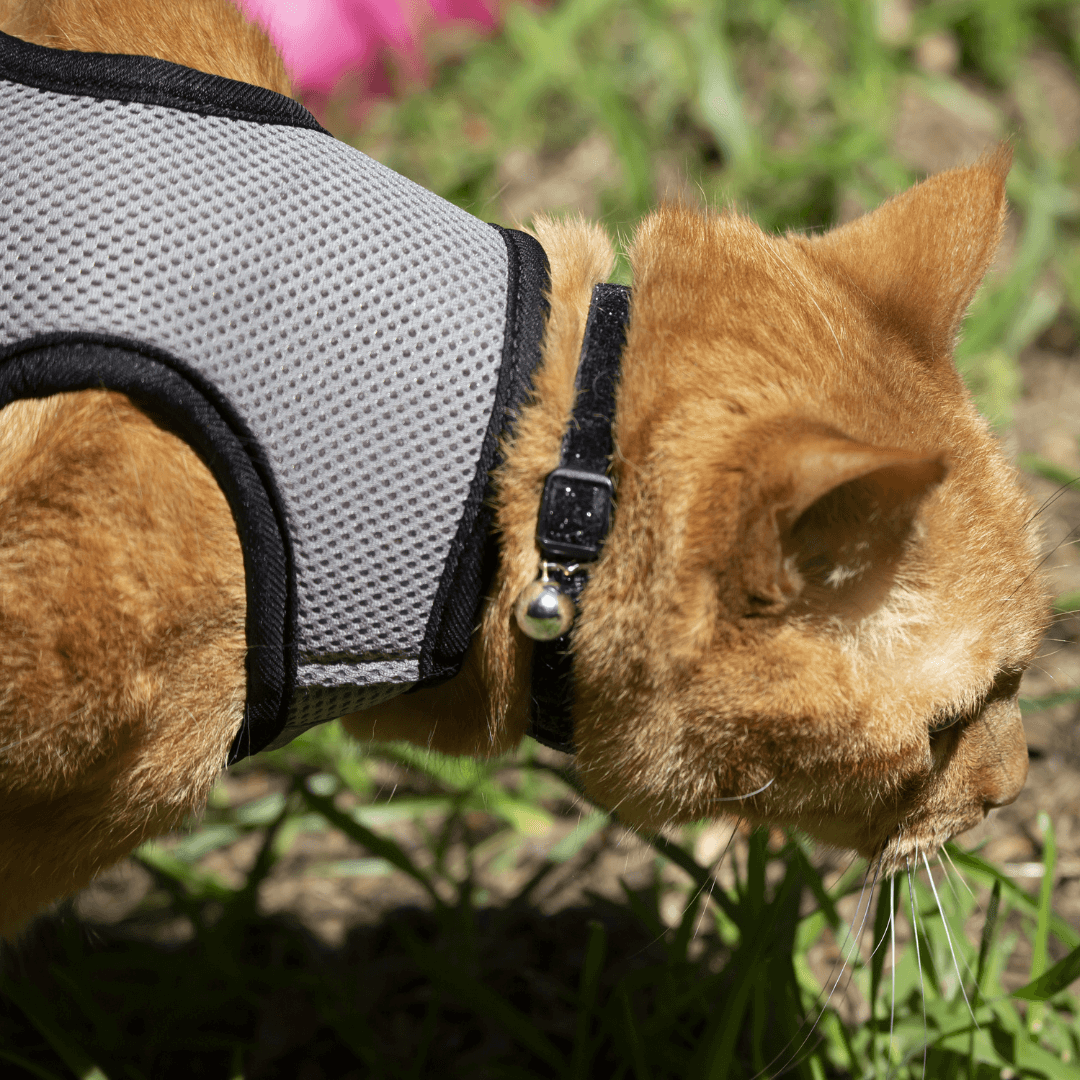
HARNESSES
Whether you want to train your cat to go on adventures with you in nature or need an extra means of restraint for backyard exploring, harnesses are an excellent tool to help your cat experience the outdoors while keeping them safer. Harnesses are also a great safety tool for indoor use, such as when you’re introducing two cats during desensitization/ counterconditioning and want to ensure that the cats stay at a certain distance. The last thing you need when you’re working on positive introduction is to have one cat get closer than the other cat’s comfort zone.
If you’ve ever tried to put a harness on your cat you know that it doesn’t always go smoothly. Some cats will plant, roll around, or fall to the ground because it feels scary or weird. But like much in behavior, positive reinforcement-based training and going slowly will help your cat see the harness as something fun. I recommend checking out this great video from Cat School on how to train your cat to wear a harness. There are a lot more steps than just putting the harness on your cat and expecting your cat to know what to do!
One extra safety note we want to mention: even if your cat is harness trained, I do NOT recommend bringing your cat to the vet or on a car trip in a harness. A harness won’t protect your cat from flying across the car if you slam on the brakes, or from being hit by a car or running away if they wiggle out of their harness once you open the door.
At the vet clinic, a harness doesn’t give your cat anywhere to hide from the scary sights/ sounds, and could also pose an additional safety risk with exposure to dogs and their teeth. For more on this topic and why cat carriers are best, check out my Instagram post about keeping your cat safe during transport to the vet here.
Kitty Holster. If you’re hoping to take your cat out into the world, I recommend a jacket harness like the Kitty Holster that covers more surface area on your cat to help keep them secured. Plus, the name is awesome!
PetSafe Come with Me harness. Another nice harness option, although maybe more suitable for supervised backyard romping.

TRAINING
Did you know that cats can be trained just like dogs? If you don’t believe me, shake a treat bag and see how quickly your cat comes zooming over. Training is a really fun way to provide the enrichment that all cats need, which supports their emotional health. It also supports the human-cat bond, and you’re only limited by your imagination. If you have a senior cat (over 10 years of age), they can be trained too! I just started training Puff a few years ago at age 14 using clicker training, and now he knows how to sit, high five, go to a station, and target among other behaviors.
When it comes to the type of training and trainer to seek out, we recommend positive reinforcement-based training for all animals including cats. This type of training is more humane and more effective. Read all about why should we avoid using aversive methods and seek reward-based training in this AVSAB position statement on humane dog training (which has similar principles with cat training).
Cat School online course. I love Cat School! Not only do they have really useful training videos like the cat harness video I highlighted in the section above, but you can enroll your cat in their online program to teach tricks, husbandry, and vital skills such as acclimating to a carrier. They have a ton of cat training videos in their YouTube library that you can watch for free.
Karen Pryor Academy Train Your Cat course. The Karen Pryor Academy is primarily focused on dogs, but this self-paced course is a fun intro to the basics of training and clicker training. Learn all about training concepts such as capturing, shaping, reinforcers, and observing your cat’s behavior for microscopic changes during the training process.
Karen Pryor Academy soft clicker. Traditional box clickers are pretty loud, and might startle your cat during training. These KPA soft clickers are a nice alternative. You can also use a tongue click (which is what I use for Puff), which is handy. Some noise-sensitive cats can do well with the click of a ballpoint pen to mark the behavior.
Terry Ryan Treat Pouch. No training session is complete without a treat pouch! Food reinforcers are an easy way to reward the behavior you want your cat to keep doing, whether it’s a trick such as spin in a circle or choosing to sit on a mat to prevent jumping on top of the counter. A treat pouch keeps those treats handy so you can mark and deliver the treat quickly.
Telescoping target stick. Back to the concept of supporting choice and control, target training is a great way to encourage voluntary movement in your cat without needing to touch them. It can also help build confidence in shy cats and be used with other types of training such as positive carrier training or teaching your cat to go to a certain location. I like this target stick because it telescopes down to save space and provides a target ball that your cat can easily see. For cats who are fearful of approaching people, the extra length on the stick helps you keep some distance from your cat so you’re not as scary to them when training.
Stationing mat. Stationing was one of the first behaviors I taught Puff because he was always countersurfing, and we wanted to teach him an alternate behavior (sitting on his mat on the floor) for which he would get rewarded with a tasty treat. He loves this non-slip, cozy mat so much that his face lights up as soon as he sees it being put down. I recommend keeping the mat picked up when not in use because you don’t want to miss an opportunity for reinforcement. Once you have your mat, start training with this great blog post from Cat School!
Stationing cot. Another behavior I wanted to work on with Puff was his propensity for jumping into my lap when working from our home office. As much as I love lap time with Puff, he makes working on a computer very difficult due to his habit of resting his forearms on our forearms. I also wanted to encourage independent behavior due to his history of having anxiety, so about a year ago we added this excellent cot to our home office.
Puff was already a pro at stationing on a mat, so we put a pet cushion on the cot and began reinforcing him multiple times a day with attention and petting whenever he was on the cot. Pretty soon, he realized that he could still get what he wanted, but just in a different location. He also loooooved the elevated perch that the cot provides.
Now he sleeps in his cot multiple times a day, and I never miss an opportunity to reward him with attention (even just verbal attention from a distance) when I see him relaxing on his cot. Cots can also come in handy when you’re introducing cats because it acts as their “station” to keep them at a distance. Additional bonus—you’re now free to move your arms again when you’re working from home!

CAT MEDIA
Hopefully you’ve explored our public feline resources page about cat health and cat behavior. For members of the Catnip Club, I wanted to highlight additional resources to help you learn even MORE about your cat.
Understanding your cat’s behavior—including the essentials of body language—help support the human-feline body and determine when your cat is feeling fear/ anxiety/ stress/ frustration/ overwhelmed.
Kitty Language. This illustrated book by Lili Chin is so fun to read and informative that I recommend it for people of all ages, including children. Body language is the fundamental building block of communication, and this is probably the most important step that cat parents can take when trying to work on a behavior problem. It will help you know when your cat wants to be left alone, when they’re enjoying petting or getting overstimulated, when they’re scared, and when they’re feeling calm. It will also help keep you safer! Swatting, growling, trying to bite don’t just happen with no warning. Your cat is actually communicating in multiple different ways prior to escalating to aggression.
Fear Free Happy Homes. I have this site listed on my public resources page, but wanted to highlight the “Cats 101” page. It’s a great overall look at cat behavior with a good body language video.
Decoding Your Cat: The Ultimate Experts Explain Common Cat Behaviors and Reveal How to Prevent or Change Unwanted Ones. Want to delve even more into cat behavior? Check out this book written by the ultimate veterinary behavior experts, the American College of Veterinary Behavior! Veterinary behaviorists are veterinarians who have undergone additional training and board certification to become specialized in animal behavior. Here, they cover the “why’s” behind types of feline behavior, common feline behavior problems, and some solutions that may help.
Play With Your Cat!: The Essential Guide to Interactive Play for a Happier, Healthier Feline. Dr. Mikel Delgado is a scientist, cat behavior consultant, and speaker, and we’ve enjoyed her talks at multiple behavior conferences. In this book, she covers some really important topics: why play is so important for feline wellbeing, and some tips and tricks on how to play with your cat.
Behavior Buzzzzzz with 2 Amys podcast. Confession: I rarely listen to veterinary or pet podcasts because I’m far too busy listening to interviews with comedians and actors. But I make an exception for Behavior Buzzzzzz because the topics are so interesting and informative! Hosted by two veterinary behaviorists (Dr. Amy Pike and Dr. Amy Learn), this podcast isn’t just for vet people, it’s for pet caregivers, pet professionals, and basically anyone with an interest in animal behavior.
The Veterinary Behaviour Chat podcast. Similar to Behavior Buzzzzzz, this podcast is hosted by a veterinary behaviorist. Dr. Katrin Jahn and covers a a variety of great topics related to animal behavior. Check out episode 13 (“When Dogs and Cats Bite”), episodes 18 and 19 (centering on a healthy feline environment and the perfect litterbox), episode 20 (“Life in a Multi-Cat Household”), and episode 70 (“Learn to Speak Cat”) to name a few. And none other than yours truly (Dr. Julie Liu, owner of My Family Cat) had the awesome opportunity to appear on episode 227 to discuss management of intercat tension. Check out the podcast episode or watch on YouTube!