
House Tigers Need to Hunt, Too: How I Introduced Food Enrichment to My Cats
The late Mr. B with a mini Buster Cube
Jump to our cat food puzzle quick tips!
My previous cat, the late Mr. Bundles, had always been food obsessed since I adopted him as a kitten from the Golden Valley Humane Society in Minnesota. He used to chomp his canned food so quickly that I could hear his teeth scraping the bottom of the bowl, and his mouth looked like a backhoe scooping giant mounds of dirt over and over until the project was completed and the bowl was empty. He was similarly fixated on dry food, and if I wasn’t careful, would bust into the food pantry and gorge himself. I started blocking the door with a 35 pound bin of Tidy Cats, but he was so determined that his tiny 11 pound body was able to force the cat litter aside to get into the pantry. His singular mission when I was at work was to access more food. The brinkmanship finally ended with two bins of Tidy Cats double-stacked, and despite all of the pull ups and leg presses I’m sure he was doing to condition himself for the challenge, he couldn’t move 70 pounds of cat litter.
Blocking access prevented him from overeating, but as is common when you begin working on cat behavior problems, it didn’t take away his underlying frustration between meals. At that time I was still feeding him twice a day, and once his breakfast or dinner was gone it would be hours before his next meal, which probably seemed like weeks in Mr. B’s timeline. As mealtime approached he would become more and more vocal and agitated, and would even take out his hanger on his two feline housemates Navin and Puff, innocent bystanders who ate their food at a normal pace.
Somehow, I stumbled upon the newish idea of food puzzles, which are stationary or mobile objects used to hide food to support their natural hunting behavior and provide mental stimulation. When used throughout the day, they also help emulate the normal feeding behavior of cats, who ideally should be multiple small meals throughout the day rather than the two giant meals I was feeding Mr. B. Not surprisingly, he had also gained a little weight, so incorporating food puzzles into his feeding regimen would have the additional benefit of getting him to move around a little more.
The first food puzzle I found for my cats was a food puzzle designed for dogs: the mini Buster Cube. It was royal blue and consisted of a hard plastic cube with a hole at the top, which you could use to fill with kibble or treats. The inside of the cube had little compartments like Swiss cheese that would trap the food, and depending on how you adjusted it, could be set to varying difficulty levels. Mr. B’s main diet was still canned food, but I began offering him a Buster Cube snack with dry food every day. He immediately became interested when he saw me filling this strange new toy, and one sniff got him pawing the cube until a kibble finally fell out. Success! Puff quickly became a fan as well, and learned to spin the cube with a quick flick of the wrist like a pro bowling a strike.
Unfortunately, this was also before I learned that you should separate cats when feeding, because soon Mr. B realized there was an easier way to get his food: by letting Puff do all the work. Whenever Puff approached the cube, Mr. B would lay back on his haunches, patiently watching and waiting. As soon as a kibble spun out, he would instantly shove his head forward to gobble it up before Puff even knew what had happened. I thought it was entertaining at first, but as I learned more and more about cat behavior, I realized that it probably wasn’t very entertaining for Puff. Inadequate number of resources (e.g., feeding stations) increases stress in cats and the need to compete, and is a common contributor to intercat conflict.
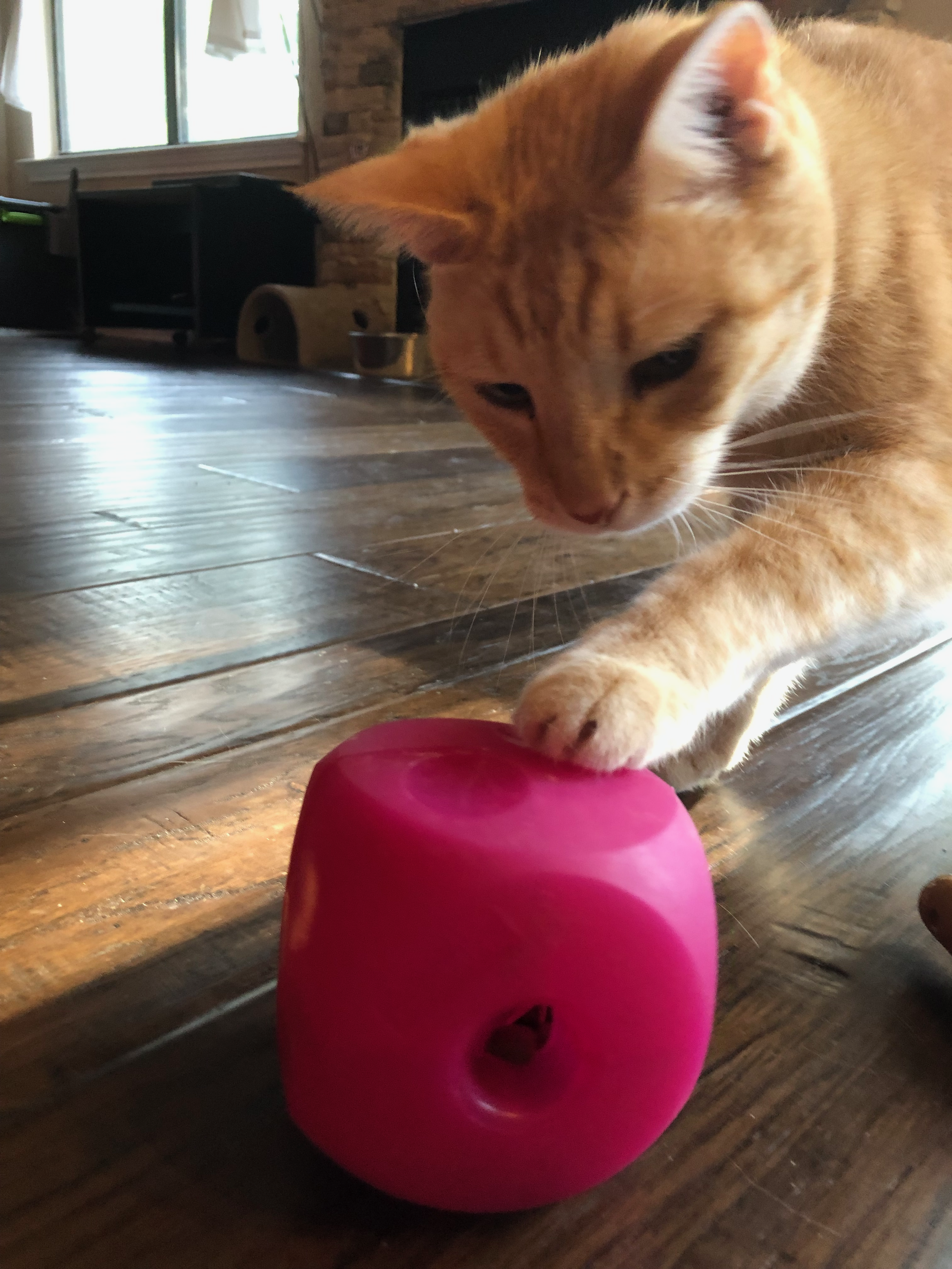
Eventually I bought a second matching pink cube for Puff (blue for B, pink for Puff) and began feeding Mr. B behind a closed door, which helped immensely. They branched out to other types of food puzzles, but their Buster Cubes always stayed in heavy rotation, especially on days when I had to go to work and leave them alone for hours. The break-in attempts to the pantry even decreased and all of the cats seemed more content.
When Mr. B was euthanized in December 2022 and Puff became my only cat, he inherited Mr. B’s cube and the rest of the extensive food puzzle collection. By that time Puff had achieved Buster Cube mastery, so I found another way to provide food enrichment: foraging. Every day, 2 to 3 times a day, I hide some of Puff’s kibbles around the house for him to seek and find. At first I made it really easy, and placed them in obvious spots like his cat beds where he was sure to stumble upon them. When I noticed him using his nose to actively smell and find the kibble, I began hiding them at different heights, under blankets, and in new areas to encourage him to explore. I also embedded a few kibbles in an elevated Snuffle Mat draped over the back of the couch. If you haven’t witnessed a cat tilting their nose in the air while they flare their nostrils and sniff sniff sniff, I assure you it’s one of the cutest sights and sounds in the world. Sniffing also releases endorphins in dogs, and I can only speculate that it does the same thing in cats. Puff is prone to generalized anxiety and being overweight, and I was thrilled to find a low-budget way to not only support his emotional health, but increase his calorie burn.

Puff demonstrating the swirl-and-twirl technique with his mini Buster Cube
If you have a cat that tends to wake you up at night, a heavy play session followed by a food puzzle before bed may help. Nighttime waking in cats can also be due to medical causes, so this concern should be discussed with a veterinarian.
Cat food puzzle quick tips
If your cat has only ever been fed in a bowl, I encourage you to try a food puzzle or foraging. A few tips to get you started:
Check out this great site on cat food puzzles. There are so many options out there, and this site lists different types and ranks them by difficulty levels. There are also DIY puzzles to help with budget, and lots of cute videos of cats using different food puzzles.
Explore dog food puzzles. Many can perform double duty, as long as the cup that holds the food is big enough for your cat’s face or paw. Snuffle Mats are great for cats as well. If they’re outside your budget, a high pile, nonslip bathmat can work in a pinch.
Make it really easy for your cat initially. Would you play a new video game that started you at the highest difficulty level? The same principle applies to giving your cat a new food puzzle. Overfill the puzzle so a little effort equals a big reward and your cat gets reinforced often.
Don’t make your cat work for all of their food at once. If your cat is hungry, this can increase frustration and stress. Try feeding them most of their regular meal, then some of the meal in the food puzzle as dessert.
Increase the value of the reward. If your cat doesn’t seem interested in hunting/ foraging for kibble, increase the value of the food being offered by switching to tasty treats that your cat really likes. You can also praise your cat and give them attention for using the puzzle.
Try a variety of food puzzles, both stationary and mobile. Some cats like to roll things around, other cats like to reach their paws into a hole or tube to drag out their “prey”.
Get the whole family involved! Kids especially will find it fun to hide treats for their cat, and it reinforces the human-cat bond.
Caution in multicat/ multispecies households. If you have a dog with resource guarding or a cat like Mr. B who likes to steal everyone’s food, leaving food puzzles or treats out could become a safety concern, or increase competition/ stress. That being said, the great thing about food as enrichment is that you can easily separate pets and offer the puzzle or foraging opportunity to an individual cat behind a closed door.
Looking for more tips on helping solve your cat’s behavior problems? Schedule a house call cat behavior consult with us in the Austin area today, and follow us on Instagram!